
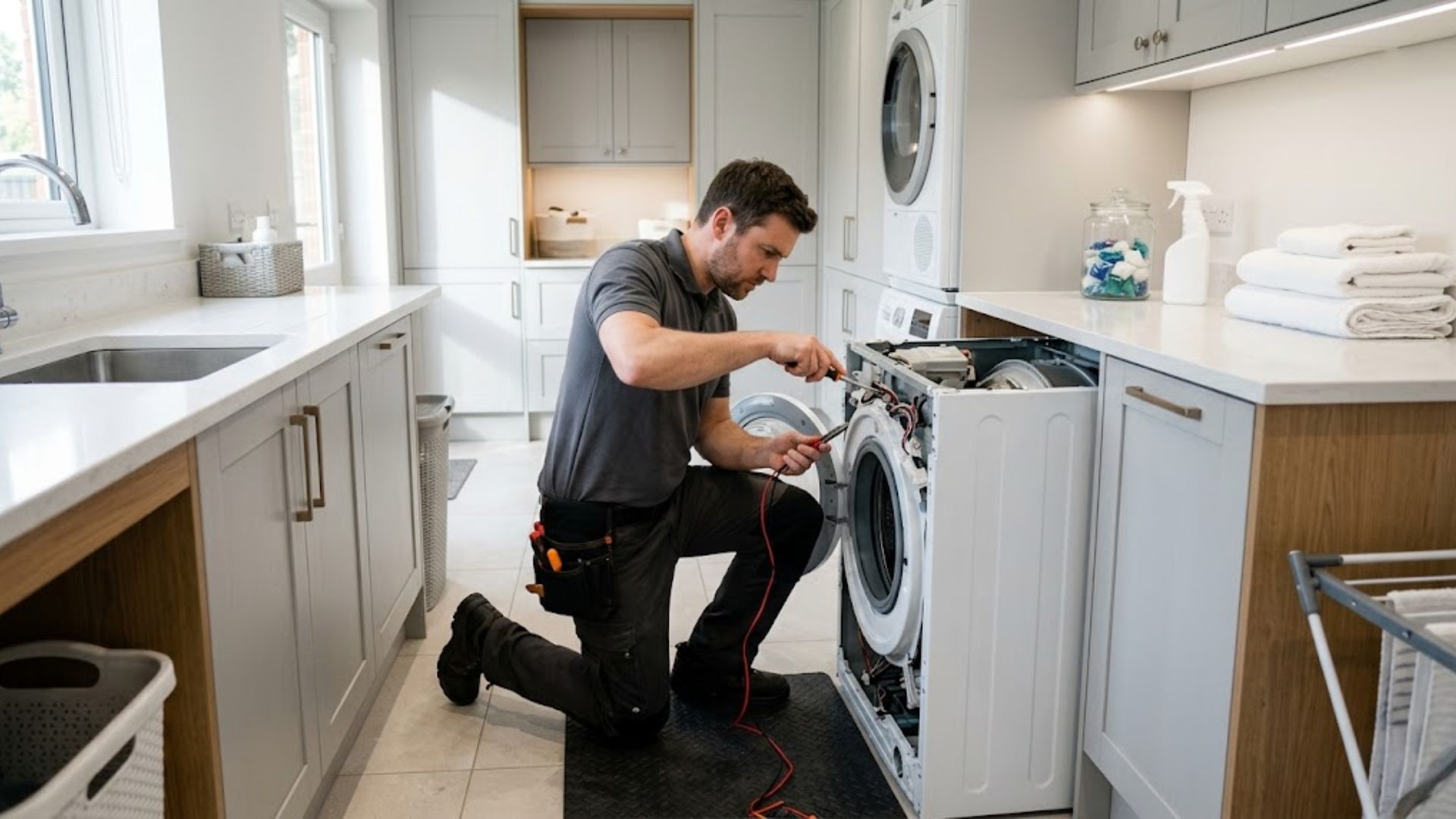
This is the single most common piece of misinformation top-load owners run into, and it comes from front-loader advice. Front-loading washers have a user-accessible drain pump filter behind a small panel at the bottom of the cabinet, and owners are told to clean it monthly. Most top-load washers have no such filter and no such panel. If you are looking for one, you will not find it, and you have not missed a maintenance task. On a top-loader a blockage generally means getting to the pump itself, which is a job for someone with the machine opened up.
Start with the simplest thing. The drain hose runs from the pump up to a standpipe or laundry tub, and it kinks easily — particularly if the machine has been pushed back against a wall after service or a move. A kinked or crushed hose stops the water leaving. So does a standpipe that has silted up over the years, which presents identically and is a plumbing problem rather than an appliance one.
The pump itself fails in two ways. It jams, usually on a coin, a button, a hair grip or a sock that has worked past the tub, and often makes a distinctive buzzing or humming noise while failing to move water. Or it fails electrically and does nothing at all. Either way it is a contained repair, typically at the lower-to-middle end of the cost range, and a competent technician will clear an obstruction rather than sell you a pump that does not need replacing.
On many top-loaders the same safety interlock that permits the spin also permits the drain. A failed lid switch can therefore present as a drainage fault, with the machine washing normally and then leaving a full tub. It is worth checking early because it is inexpensive.
The two are linked on most machines, both mechanically and in the control logic, which is why "will not drain" and "will not spin" so often arrive as one complaint. That is useful diagnostic information rather than a sign of two separate problems — a single fault, frequently a lid switch or a pump, explains both.
Switch the machine off at the wall. Check the drain hose for kinks along its whole length and make sure it is not pushed too far down the standpipe. Check the standpipe drains freely by pouring water into it. Check the lid closes properly. If the machine is full, you will need to bail or siphon it before anything else happens, and doing that before the technician arrives saves time and usually money.
A kinked hose costs nothing but the call-out. A jammed pump cleared of an obstruction is at the cheap end. A replacement drain pump is typically a low-to-middle repair, and a lid switch commonly $100 to $200. Diagnostic call-out fees generally run $75 to $130 and are often credited against the work.
Tell us the brand and what it is doing. Free quote, no obligation.
What the machine does, and at which point in the cycle.
A local technician gives you a flat price before any work starts.
Depends on your local partner's schedule — we'll give you a straight answer.
They're an independent business. If it's not right, we'll send another partner at no extra cost.