
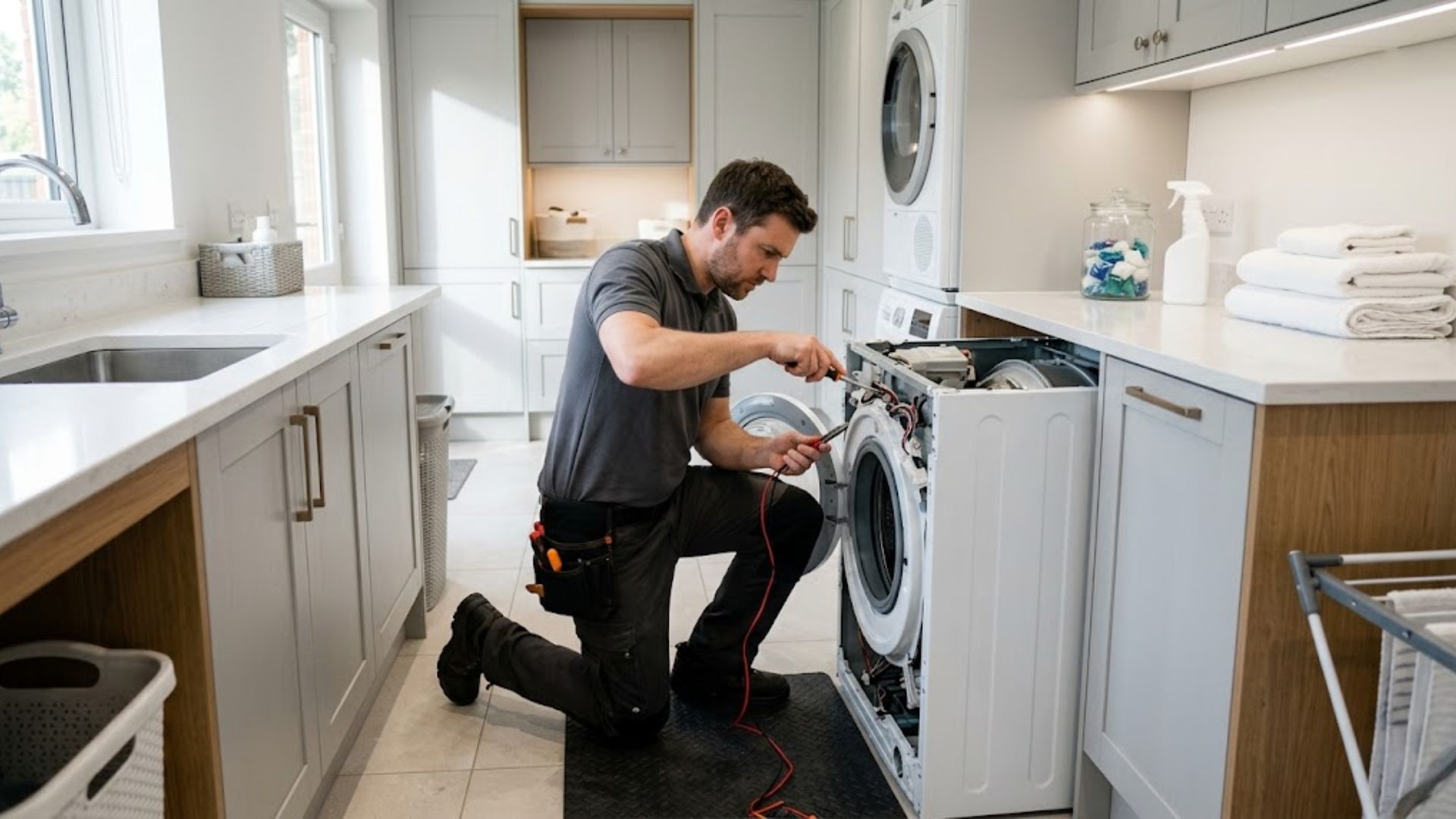
A top-load washer that is not sitting level on all four feet will rock, walk and bang no matter how healthy its internals are — and leveling is something you can do yourself in ten minutes with a spirit level and an adjustable spanner. Get all four feet in firm contact with the floor, check the machine does not rock when you push a corner, and tighten any locknuts. A surprising share of shaking complaints end here, and no honest technician will sell you suspension rods before checking it.
The same machine can be perfectly quiet on a concrete slab and unbearable on a first-floor timber joist. Old housing stock, springy floors and pedestal installations all amplify normal spin vibration into something alarming. A sheet of plywood spreading the load, or moving the machine to a stiffer part of the floor, can fix a problem no part replacement would have solved.
A top-loader hangs its tub from suspension rods with damping built into them. As that damping wears out, the tub begins to swing further on every spin, and the machine starts knocking against its own cabinet and walking. Rods wear as a set and are normally replaced as one, and it is a well-understood, middle-of-the-range job. The symptom builds gradually, which is why owners often only notice once it is bad.
Around the top of the tub is a ring partly filled with fluid, which shifts to counteract an uneven load. If it cracks and loses that fluid the machine loses its primary defense against imbalance, and no amount of careful loading fully compensates. This one usually shows as a machine that is fine with a full even load and violent with a single heavy item.
Electronic top-loaders detect imbalance and respond — redistributing, refilling to re-float the load, slowing the spin, or halting with a code. Whirlpool and Maytag machines show uL or oL, LG shows UE, Samsung shows UB or U6. A machine that trips these constantly with normal loads has a mechanical problem behind it. A machine that trips on a single bath mat or a duvet is behaving correctly.
Top-loaders cope badly with one heavy item on its own, and with loads packed above the top of the agitator. Bath mats, single duvets and heavy coats are the usual offenders. Spreading the load around the agitator rather than wrapping it in a lump makes a real difference, and on impeller models an even spread across the plate matters more still.
Leveling is free. A sheet of plywood is a few dollars. Suspension rods are a middle-range repair, replaced as a set. A balance ring is more involved because it means getting into the tub. It is worth fixing — an unbalanced spin puts steady load into the bearing, the transmission and the cabinet, so leaving it alone reliably turns a moderate repair into a larger one.
Tell us the brand and what it is doing. Free quote, no obligation.
What the machine does, and at which point in the cycle.
A local technician gives you a flat price before any work starts.
Depends on your local partner's schedule — we'll give you a straight answer.
They're an independent business. If it's not right, we'll send another partner at no extra cost.