
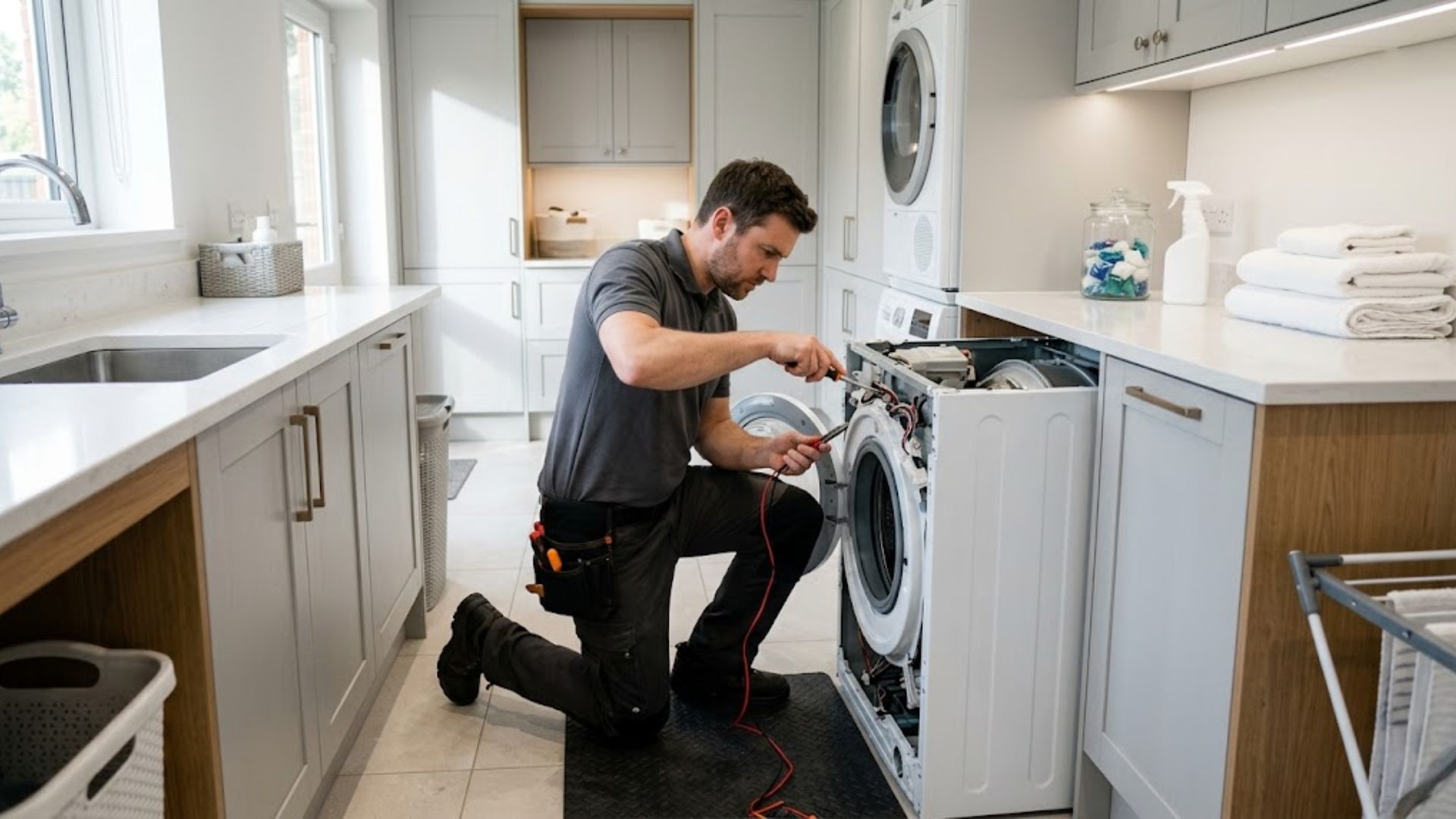
It sounds too simple, but a partially closed supply tap is a genuinely common cause of a slow fill, and taps get nudged during any work behind the machine. Check both hot and cold are fully open. Then check the hoses are not kinked where the machine sits back against the wall. This costs nothing to rule out and saves a call-out fee often enough to be worth doing before you pick up the phone.
Behind the point where each supply hose screws into the machine sits a fine mesh screen, there to stop sediment and grit reaching the valve. In hard-water areas those screens clog steadily with mineral deposit, and the fill gets slower and slower — a machine that used to fill in four minutes can end up taking ten or more. This is the single most common fill complaint across the hard-water states, and it is often a cleaning job rather than a parts job. A technician who replaces the valve without checking the screens has charged you for the wrong thing.
The valve is a pair of electrically operated solenoids that open to let water through. They fail: sometimes one side only, which gives you a machine that fills on cold but not hot, or takes forever on a warm wash. Sometimes the valve fails to close fully instead, and the tub slowly fills while the machine is switched off — the opposite symptom, same part, and a more urgent one because it can overflow.
The machine knows how full the tub is through a pressure switch connected to an air dome tube at the bottom of the tub. If that tube blocks with lint and detergent sludge, or splits, the switch reads the tub as already full and stops the fill early — or reads it as empty and overfills. Owners usually describe this as the washer "filling a bit and then just washing", and it is a cheap fault with a dramatic presentation.
Many top-loaders will not begin filling until they are satisfied the lid is closed, so a failed lid switch can present as a no-fill rather than a no-spin. Less commonly the timer or control board is at fault. A technician works through these in order of cost, which means the cheap electrical checks come before anything gets replaced.
Open both taps fully. Straighten the hoses. Disconnect the hoses at the machine — with the taps off — and look at the screens; if they are furred with white deposit, that is your answer. Listen when a cycle starts: a humming from the valve with no water arriving suggests the valve or the screens, while complete silence suggests the machine has not asked for water at all, which points at the lid switch, pressure switch or control.
Cleaning clogged screens is often done within the diagnostic visit. A water inlet valve is a low-to-middle repair. A pressure switch or air dome tube is inexpensive. A control board is the expensive end and is rarely the actual cause. Diagnostic call-out fees generally run $75 to $130, often credited against the repair.
Tell us the brand and what it is doing. Free quote, no obligation.
What the machine does, and at which point in the cycle.
A local technician gives you a flat price before any work starts.
Depends on your local partner's schedule — we'll give you a straight answer.
They're an independent business. If it's not right, we'll send another partner at no extra cost.